
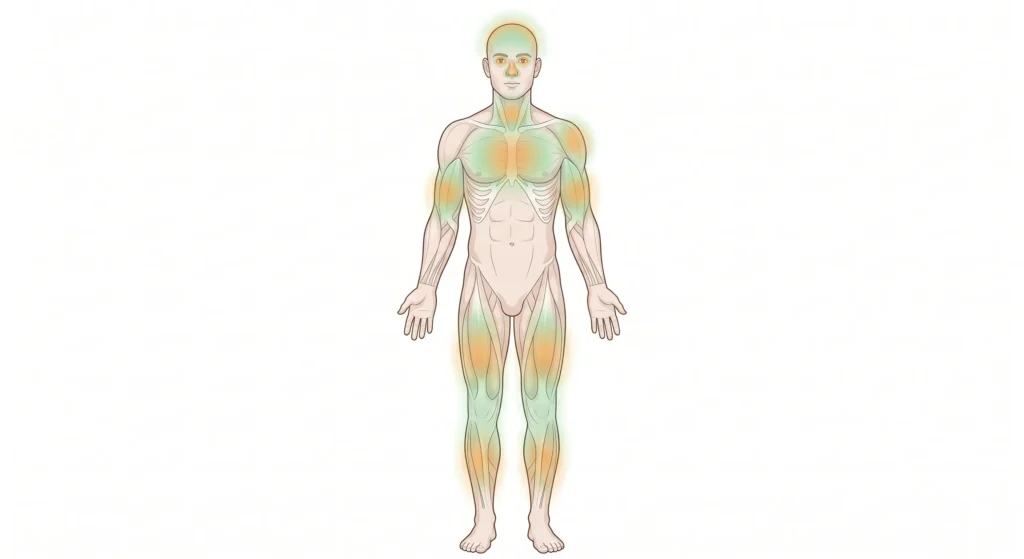
One of the most confusing things about Post Orgasmic Illness Syndrome (POIS) is that it does not look the same in every man. One man’s POIS attack comes with crushing tiredness and brain fog. Another man’s looks more like a bad allergic reaction, with burning eyes, a stuffed-up nose, and sneezing. A third man gets hit with muscle pain so bad he can barely walk up stairs.
This is not random. It is actually organized.
When researcher Marcel Waldinger studied 45 men with POIS, he found that the symptoms, as different as they were from person to person, fell into seven distinct groups. Understanding these groups does two important things. It helps men figure out which version of POIS they are dealing with, and it gives doctors a clearer picture to work with when trying to diagnose and treat it.
Think of these seven groups not as a checklist where you need to check every box, but as a map of possible symptoms. Most men with POIS experience symptoms from more than one group at the same time during an attack. Some groups are almost universal, showing up in 80 to 90% of men with POIS. Others are less common but just as real for the men who experience them.
One thing stays the same across all seven groups. Symptoms start within seconds to 30 minutes of ejaculation in most cases, get worst between 12 and 48 hours later, and then go away on their own within 2 to 7 days or even prolong to months and years.
Here is what each group looks like.
Group 1: General Symptoms
This is the most commonly reported group, showing up in roughly 80 to 87% of men with POIS. It is also the group most likely to be mistaken for something else, like depression, chronic fatigue, or a viral infection.
Symptoms in this group include extreme tiredness and exhaustion, heart palpitations, trouble finding words or finishing sentences, difficulty concentrating, getting irritated very easily, not being able to handle loud noise or bright light, and a low mood that does not lift until the attack passes.
The thinking and speaking problems are worth paying special attention to. Men describe searching for a simple word mid-sentence and finding it completely gone. Some say they can hear themselves speaking but feel disconnected from what they are saying, like the link between their thoughts and their words has been cut. This is not just tiredness. It is a real disruption in how the brain functions, and it clears up on its own when the attack ends.
Group 2: Flu-Like Symptoms
This group shows up in around 78% of men with POIS. It is what makes the condition look so much like a regular illness, which is part of why it gets missed so often.
Symptoms include feeling feverish, going back and forth between feeling very hot and very cold, sweating heavily, and feeling generally terrible in that all-over way that is hard to describe but impossible to ignore. Men often say it feels exactly like the first hours of a bad flu, that specific sense of the body gearing up to fight something serious.
The key difference from an actual flu is this. It starts within minutes of orgasm, runs its course in a predictable window, and then comes back exactly the same way the next time. A real flu does not do that.
Group 3: Head Symptoms
This group covers everything from tension headaches to a deep mental fog that men struggle to put into words. The most common descriptions are a foggy feeling inside the head, a heavy pressure as if the skull has been packed with something thick and slow-moving, and a sense that clear thinking takes physical effort.
These symptoms live somewhere between neurological and physical. The brain is not just tired. It feels like it is trying to work through interference, like a radio signal fighting through static. Men often describe feeling mentally unreachable, even to themselves.
Group 4: Eye Symptoms
Around 44% of men with POIS experience eye symptoms. This group is one of the most distinctive signs of the condition and one of the clearest differences between POIS and ordinary tiredness after sex.
Symptoms include burning eyes, red and visibly inflamed eyes, blurry vision, watery or runny eyes, persistent itching, and sometimes actual pain. The way the eyes look and feel is very similar to a severe allergic reaction. This fits with one of the leading theories about POIS, which suggests the body is reacting to proteins in its own semen as if they were foreign invaders.
For men who get this group strongly, the eye symptoms are often the first clear sign that a POIS attack has begun.
Group 5: Nose Symptoms
This group is closely connected to the eye group in how it behaves, and it affects around 33% of men with POIS. Symptoms include a stuffed-up nose, a watery or runny nose, and sneezing. It gets mistaken for the start of a cold or seasonal allergies all the time.
When a man experiences both Group 4 and Group 5 together, burning watery eyes and a congested runny nose at the same time, the combination looks almost exactly like a moderate allergic reaction. That is not a coincidence. It points to the same underlying immune response that researchers believe is driving much of what POIS does to the body.
Group 6: Throat Symptoms
This group is talked about less than the others, but it is genuinely distressing for men who experience it. Symptoms include a bad or strange taste in the mouth, dry mouth, a sore throat, a tickling cough that will not go away, and a hoarse or changed voice.
These symptoms look like what happens when the body’s mucous membranes, the wet linings of the mouth, throat, and airways, are reacting to something they have decided is a threat. Men who experience this group often say it is one of the strangest parts of their POIS attacks because it is so hard to explain to anyone else.
Group 7: Muscle Symptoms
The last group involves the muscles and the body’s movement system. Symptoms include muscle tension in the neck and back, weakness throughout the body, widespread muscle pain, legs that feel too heavy to lift easily, and a general stiffness that makes moving feel like hard work.
Some researchers have pointed out an interesting similarity between these muscle symptoms and the soreness that comes a day or two after intense exercise. Both involve inflammation and both can affect the same muscles. The difference is that POIS muscle symptoms are not caused by working out. They are caused by ejaculation. They show up whether the man spent the hour before running a race or lying completely still.
What Your Symptom Pattern Tells You
No two men experience POIS through the exact same combination of groups, and that variability matters when it comes to treatment. A man whose POIS is mostly Group 4 and Group 5, the eye and nose symptoms, may respond well to antihistamines. A man whose worst symptoms are in Group 1 and Group 3, the general and head symptoms, may need a completely different approach.
This is why keeping a detailed record of your symptoms matters when you go to see a doctor. Not just “I feel sick after sex” but which groups are affected, how bad each one is, how quickly they start, and how long each one lasts. The more specific your information, the more useful it is in pointing toward the right treatment.
Whatever combination of groups a man experiences, one thing is true across all of them. The symptoms are not in his head. They are not a sign of psychological weakness. They are not a normal part of male sexuality.
They are the body reacting to something it does not yet fully understand. And the men who have spent years wondering why this keeps happening to them are increasingly finding that science, slowly, is starting to ask the same question.
👉 To gain more insights on Post Orgasmic Illness Syndrome (POIS), read our in-depth article on the condition here: Why Millions of Men Feel Sick After Sex
Frequently Asked Questions
Do all men with POIS experience all seven groups?
No. Most men experience symptoms from more than one group but rarely from all seven. The general symptoms group is the most common, showing up in around 87% of men with POIS. The pattern varies from person to person but tends to stay consistent for the same person across different attacks.
Can POIS symptoms change over time?
Yes. Some men find that the groups that affect them most shift over the years. Symptoms that were mild can become more prominent, and vice versa. Changes in overall health, stress levels, and nervous system regulation may all play a role in this.
Why do some men mostly get thinking problems while others get physical symptoms?
The exact reason is not yet known. Researchers think it may have to do with individual differences in immune response, hormone levels, trauma, and nervous system sensitivity. This is part of why POIS is best understood as a syndrome, meaning a group of related conditions that can look quite different depending on the person, rather than one single uniform illness.
Is there a pattern to which POIS symptoms group show up first?
In many cases, the general and flu-like groups appear first, usually within 30 minutes of ejaculation. Eye and nose symptoms may follow within a few hours. Muscle symptoms sometimes develop or get worse the next day. But this varies a lot from person to person.
This article is for informational purposes only and does not constitute medical advice. Always consult a qualified healthcare professional regarding any medical condition.
References
Waldinger MD, Meinardi MM, Zwinderman AH, Schweitzer DH. Postorgasmic illness syndrome (POIS) in 45 Dutch caucasian males: clinical characteristics and evidence for an immunogenic pathogenesis. Journal of Sexual Medicine. 2011 Apr;8(4):1164-70. doi: 10.1111/j.1743-6109.2010.02166.x. PMID: 21114609.